Why Startups Choose Offshore QA Teams
Learn why many startups opt for offshore QA teams to gain cost efficiency, flexible scaling, and expert, independent testing without the overhead.

- Offshore QA teams help startups scale quality efficiently
- Cost savings should never come at the expense of process
- Independent validation improves release confidence
- Clear communication is essential for success
- The right QA partner works as an extension of your team
Introduction
As startups grow, software quality becomes increasingly difficult to manage. Releases become more frequent, user expectations rise, and internal teams are stretched thin.
This is where many startups begin exploring offshore QA teams.
But outsourcing QA isn’t just about reducing costs. When done correctly, it’s a strategic decision that enables speed, scalability, and independent quality validation, which are key to building product confidence.
At KualitySoft, we work with UK startups and scaleups that want reliable QA without the overhead of building large in-house teams. Here’s why offshore QA is becoming a preferred model — and how to make it work.
Why QA Becomes a Bottleneck for Growing Startups
In the early stages, QA is often handled by developers or a single tester. As the product grows, this approach breaks down.
Common challenges include:
- Limited testing coverage
- Release delays due to regression issues
- Developers testing their own work
- Rising defect rates in production
Hiring a full in-house QA team isn’t always feasible due to cost, time, and management overhead.
This is where offshore QA teams offer a practical alternative.
What Is an Offshore QA Team?
An offshore QA team is a dedicated or semi-dedicated testing team located outside your primary market, working as an extension of your product team.
Unlike ad-hoc freelancers, a structured offshore QA partner provides:
- Defined processes
- Consistent resources
- Clear reporting
- Long-term engagement
The goal isn’t just execution — it’s quality ownership.
Key Reasons Startups Choose Offshore QA Teams
1. Cost Efficiency Without Compromising Quality
Hiring locally in markets like the UK can be expensive — especially for specialised QA roles.
Offshore QA teams allow startups to:
- Access skilled testers at lower costs
- Avoid recruitment and onboarding overhead
- Scale QA efforts without long-term commitments
Cost savings are real — but only when paired with proper processes.
2. Faster Scaling and Flexibility
Startups don’t grow linearly. One release may need minimal testing, while another requires intensive coverage.
Offshore QA teams offer:
- Flexible team sizes
- Quick ramp-up and ramp-down
- No long-term HR burden
This flexibility is critical for fast-moving product teams.
3. Independent Quality Validation
Developers testing their own code often miss issues — not due to lack of skill, but familiarity.
An offshore QA team provides:
- Independent validation
- Fresh perspective
- Risk-focused testing
This independence significantly improves release confidence.
4. Access to Specialised QA Skills
Modern QA goes beyond clicking through screens.
Offshore QA teams often bring expertise in:
- Manual testing
- Automation testing
- Performance testing
- Cross-browser and cross-device testing
This breadth is difficult to maintain internally for small teams.
5. Faster Feedback Cycles
With time zone overlap and structured reporting, offshore QA teams can:
- Test overnight
- Provide early feedback
- Reduce development idle time
When managed correctly, this accelerates delivery rather than slowing it down.
Common Concerns About Offshore QA (And the Truth)
“Communication Will Be Difficult”
This is a valid concern — but it’s a process issue, not a geography issue.
Clear communication frameworks solve this:
- Defined points of contact
- Regular sync calls
- Written test reports
“Quality Will Be Lower”
Quality depends on:
- Process maturity
- Tester experience
- Accountability
A well-managed offshore QA partner often outperforms rushed in-house testing.
“We’ll Lose Control”
In reality, offshore QA improves visibility through:
- Structured reporting
- Clear metrics
- Transparent defect tracking
Control improves when expectations are clearly defined.
How to Choose the Right Offshore QA Partner
Not all offshore QA teams are equal. Before partnering, ensure they offer:
- Clear testing methodology
- Dedicated QA ownership
- Transparent reporting
- Domain understanding
- Willingness to adapt to your workflow
Avoid teams that promise “100% bug-free software” — that’s not how QA works.
How KualitySoft Works as an Offshore QA Partner
At KualitySoft, we position ourselves as an extension of your product team, not a disconnected vendor.
Our approach includes:
- Early onboarding into your product context
- Manual and automation testing tailored to your stage
- Clear defect reports with business impact
- Continuous feedback and improvement
We focus on long-term quality, not short-term test execution.
When Offshore QA Makes the Most Sense
Offshore QA is ideal when:
- Your product is growing rapidly
- Release cycles are becoming frequent
- Internal teams are overloaded
- Quality issues are impacting users
It’s not about replacing your team — it’s about supporting it.
Final Thoughts
Offshore QA teams succeed when they are treated as partners, not vendors.
Startups that invest in the right offshore QA relationship gain:
- Better release confidence
- Faster iteration
- Reduced operational stress
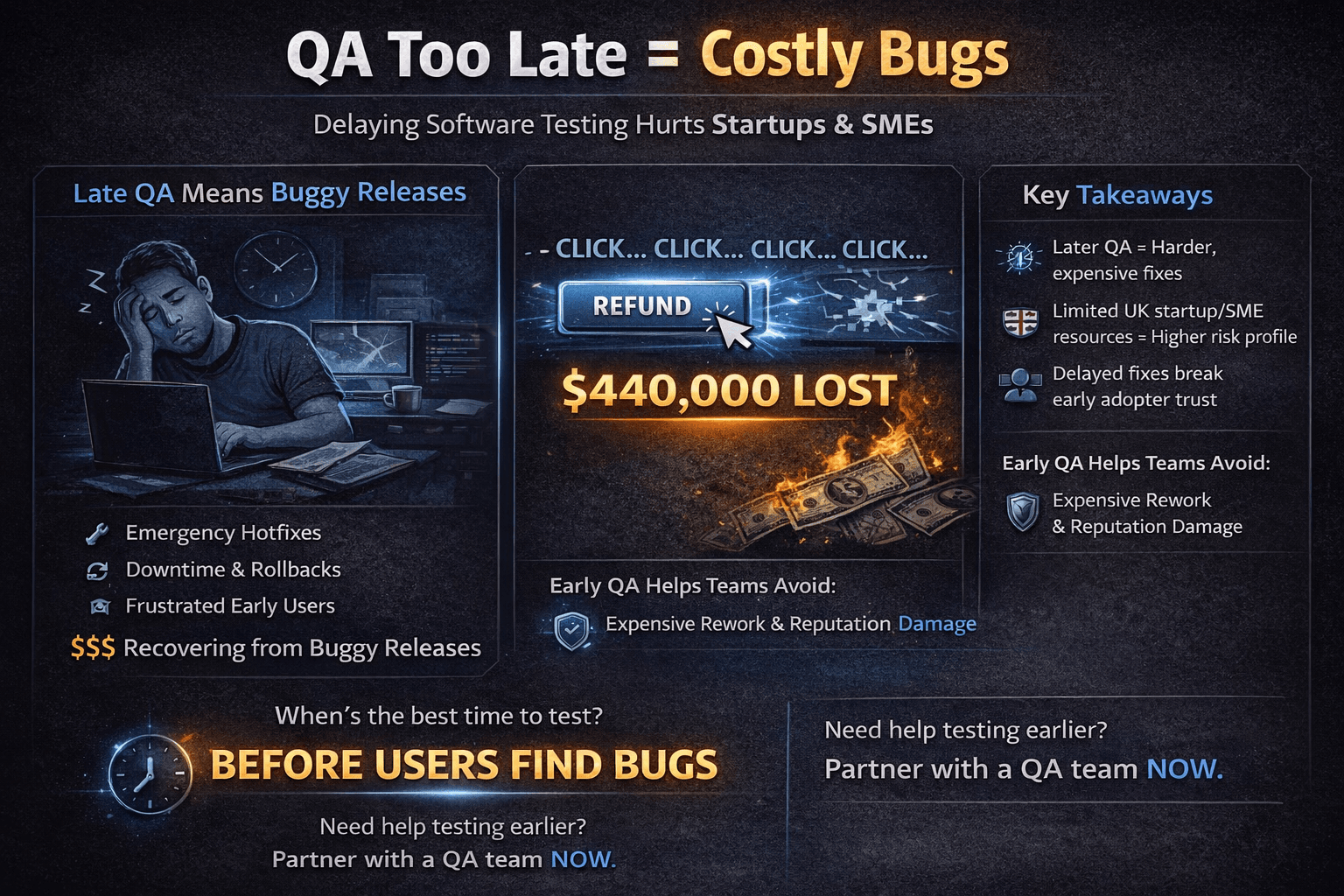
Quality becomes a growth enabler — not a bottleneck, proving why early QA is so crucial.