How Quality Assurance Builds Startup Product Confidence (And Why It Matters)
QA is more than just finding bugs—it’s about building the confidence your startup needs to release, scale, and win user trust. Here’s why it matters.

- QA builds confidence, not just defect lists.
- Early QA involvement reduces long-term risk and prevents high-impact failures.
- A strategic balance of manual and automation testing is crucial as a product matures.
- Independent QA provides objective, user-focused validation that improves product quality and decision-making.
- Confident teams release faster, innovate more freely, and build stronger user trust.
Introduction
For startups, confidence is everything.
- Confidence to release.
- Confidence to onboard users.
- Confidence to demo to investors.
Yet many startups move forward with uncertainty — not because they lack innovation, but because they lack confidence in their product’s quality.
This is where Quality Assurance (QA) plays a far more important role than simply “finding bugs.” Done right, QA builds trust, stability, and momentum — all essential for startup growth.
At KualitySoft, we work with startups and scaleups that want to move fast without breaking trust. Here’s how QA directly impacts product confidence and long-term success.
What Is Product Confidence?
Product confidence is the belief that:
- Your software works as expected
- Users can complete key journeys without friction
- Releases won’t introduce critical issues
- Problems are identified before users find them
This confidence doesn’t come from assumptions — it comes from structured validation.
QA is the mechanism that turns assumptions into evidence.
Why Startups Often Lack Product Confidence
Early-stage teams face unique challenges:
- Rapid feature changes
- Limited testing resources
- Tight deadlines
- Pressure from users and investors
As a result, many startups:
- Skip proper testing
- Rely on developers to self-test
- Release with known risks
This creates anxiety around every deployment — even when things appear “ready.”
QA Is Not About Perfection — It’s About Risk Awareness
One of the biggest misconceptions is that QA exists to eliminate all bugs.
That’s unrealistic.
Instead, QA helps teams:
- Understand where risks exist
- Decide what’s acceptable
- Prevent high-impact failures
Confidence doesn’t come from zero defects — it comes from knowing what could go wrong and having tested it.
How QA Builds Confidence at Every Startup Stage
Early-Stage / MVP
At this stage, QA helps validate:
- Core user journeys
- Business logic assumptions
- Usability issues
Manual testing plays a major role here, as requirements are still evolving.
Result:
Founders gain confidence that the MVP delivers real value — not just functionality.
Early Growth Stage
As users increase, so do risks.
QA helps by:
- Preventing regression issues
- Ensuring new features don’t break existing ones
- Introducing selective automation
This stage is where confidence shifts from “it works” to “it works consistently.”
Scale-Up Stage
At scale, confidence depends on:
- Stability across devices and platforms
- Predictable release cycles
- Reliable monitoring and reporting
QA evolves into a structured process combining automation, manual validation, and risk-based testing.
QA and User Trust Are Directly Connected
Users don’t care how innovative your idea is if:
- The app crashes
- Payments fail
- Workflows are confusing
Each visible defect chips away at trust.
QA helps protect:
- Brand reputation
- Customer retention
- Word-of-mouth growth
A single bad release can undo months of progress.
QA Improves Decision-Making — Not Just Code Quality
Good QA doesn’t just report bugs.
It provides insights such as:
- Which areas are most fragile
- Where users struggle
- What features introduce the most risk
These insights help product teams make better decisions, not just fixes.
The Role of Independent QA in Building Confidence
When teams test their own work, blind spots are inevitable.
Independent QA teams:
- Question assumptions
- Test from a user perspective
- Focus on risk, not intent
This independence is why many startups work with offshore QA teams or specialised QA services providers.
How KualitySoft Helps Build Product Confidence
At KualitySoft, we don’t position QA as a checkbox. We treat it as a confidence-building function.
Our approach focuses on:
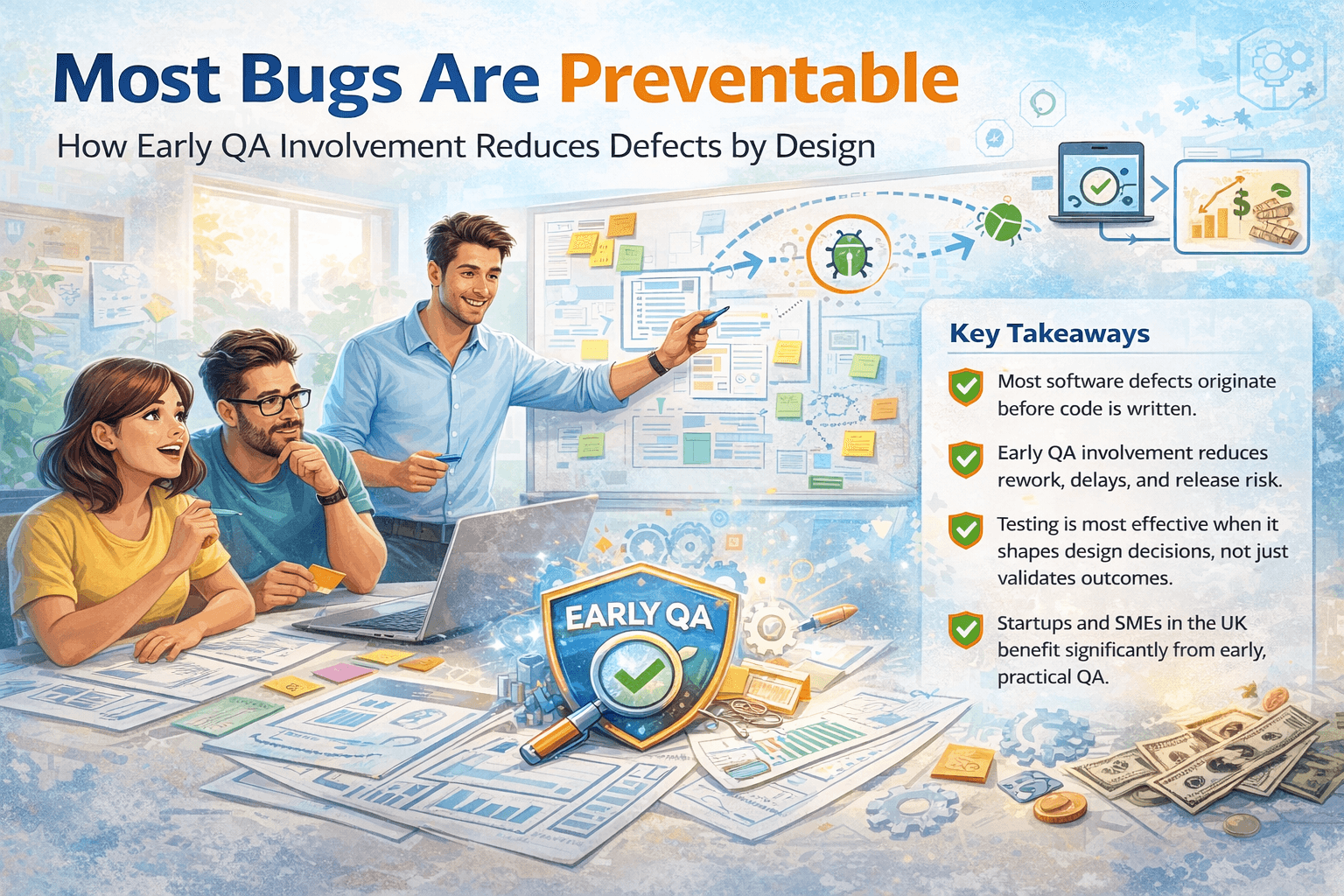
- Early QA involvement
- Manual + automation balance
- Real user scenario testing
- Clear, actionable reporting
We work as an extension of your team — not just a testing vendor.
Why Confident Teams Move Faster
Ironically, teams that invest in QA early often move faster than those that don’t.
Why?
- Fewer emergency fixes
- Less rework
- More predictable releases
Confidence reduces hesitation — and hesitation slows growth.
QA as a Competitive Advantage
In crowded markets, quality becomes a differentiator.
Startups that consistently deliver stable, reliable software:
- Retain users longer
- Earn trust faster
- Scale more smoothly
QA isn’t just a technical function — it’s a business advantage.
Final Thoughts
Product confidence doesn’t come from hoping things will work. It comes from knowing they’ve been tested the right way.
Quality Assurance is not about slowing teams down — it’s about enabling them to move forward with certainty.