What Does a Software Testing Company Do? A Practical Guide for Startups & SMEs
A practical guide explaining what a software testing company does, when you need one, and how it helps startups and SMEs deliver better software with fewer risks.
- A software testing company validates software before it reaches users, identifying bugs, usability issues, and security risks.
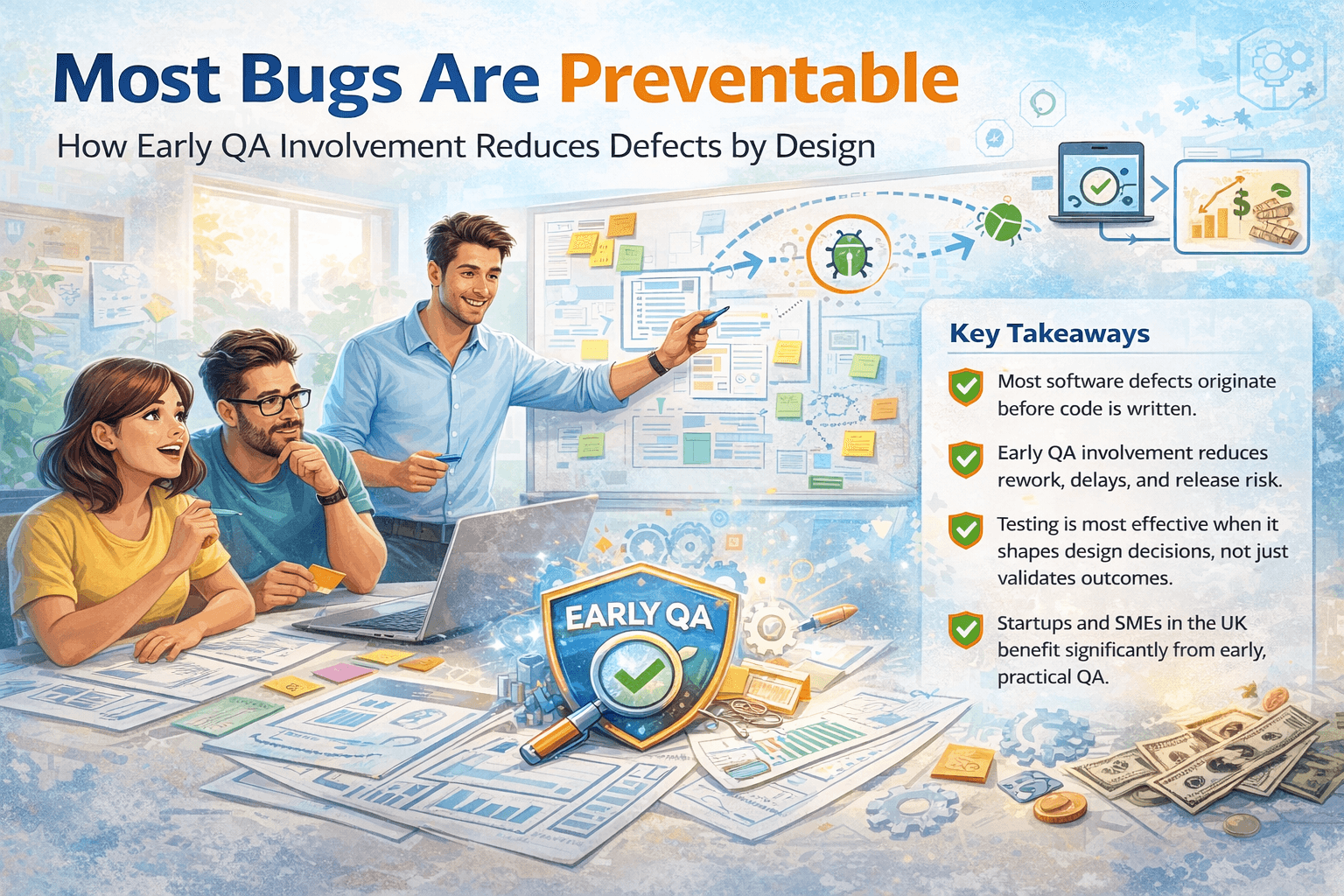
- Startups benefit greatly from early QA to avoid costly rework, build user trust, and protect their brand reputation.
- Key services include manual and automation testing, functional, usability, performance, and security testing.
- Hiring a QA partner is crucial when your product is user-facing, growing in complexity, or when quality issues start to affect users.
Introduction
For many startups and growing businesses, software testing is often misunderstood or delayed until problems surface. Yet, software testing companies play a critical role in ensuring products are reliable, scalable, and ready for real users.
This guide explains what a software testing company actually does, when you need one, and how it helps startups and SMEs deliver better software with fewer risks.
What Is a Software Testing Company?
A software testing company helps organisations ensure their software works as expected before it reaches users.
This includes identifying:
- Functional defects
- Usability issues
- Performance bottlenecks
- Security vulnerabilities
- Compatibility problems across devices and platforms
Unlike development teams, testers approach software from a user and risk perspective, focusing on how real people interact with the product.
What Services Does a Software Testing Company Provide?
Most professional QA companies, including KualitySoft, offer a range of testing services depending on product maturity and risk level.
Common Software Testing Services
- Manual Testing – Human-led testing to validate usability and edge cases
- Automation Testing – Automated checks for regression and repetitive scenarios
- Functional Testing – Ensuring features behave as intended
- Usability Testing – Improving user experience and flow
- Performance Testing – Validating speed, load, and stability
- Compatibility Testing – Testing across browsers, devices, and operating systems
- End-to-End Testing – Validating complete user journeys
Each service plays a different role in protecting product quality.
Why Startups and SMEs Need Software Testing
Smaller teams often believe QA is only for large enterprises. In reality, startups and SMEs benefit the most from early testing.
Common Problems Without QA
- Bugs discovered after release
- Negative user reviews
- Emergency hotfixes
- Slower feature delivery
- Loss of early customer trust
Software testing helps teams:
- Catch issues early
- Reduce long-term costs
- Release with confidence
- Protect brand reputation
When Should You Hire a Software Testing Company?
You don’t need QA on day one — but you do need it before risk increases.
Key Signals It’s Time for QA
- Your product is live or nearing launch
- Users are reporting issues
- Features are becoming complex
- Releases are frequent
- Revenue depends on software reliability
Engaging QA early helps prevent costly surprises later.
How a Software Testing Company Works With Your Team
A good QA partner integrates seamlessly with your workflow.
Typical Engagement Flow
- Requirement review & risk analysis
- Test planning and strategy
- Test execution (manual and/or automation)
- Defect reporting with clear evidence
- Retesting and validation
- Release readiness assessment
The goal is collaboration — not slowing development down.
In-House QA vs Outsourced QA
Both models have advantages.
In-House QA: Offers full-time availability but at a higher cost and with more hiring effort.
Outsourced QA: Provides a flexible, cost-effective solution with access to experienced testers that can scale with demand.
Many startups choose outsourcing to get enterprise-level QA without long-term overhead.
Why Choose KualitySoft as Your Software Testing Partner?
At KualitySoft, we combine 20+ years of QA experience with a practical, startup-friendly approach.
We focus on:
- Real user scenarios
- Risk-based testing
- Clear communication
- Actionable reporting
- Long-term quality improvement
Our goal is simple: help you release better software with confidence.